
Fujifilm X-T5 Mirrorless Camera Review: Image Quality and Design

Affiliate disclosure: Some links on this page are affiliate links. If you buy through them we earn a small commission at no extra cost to you. Recommendations are research-driven; we don't claim personal use of every product reviewed. Product prices and availability are accurate as of the date published and are subject to change. Always check Amazon for current pricing before purchasing. Learn more.

Film simulation modes for in-camera JPEG quality
See Fujifilm X-T5 Mirrorless Digital Came… on AmazonThe Fujifilm X-T5 occupies a specific and well-defined place in the Fujifilm Cameras lineup , a 40-megapixel APS-C body built around the X-Trans CMOS 5 HR sensor, housed in a compact, dial-heavy chassis that prioritizes tactile control over menu navigation. It is not trying to compete with Sony or Canon on autofocus speed or video versatility. It is making a different argument entirely.
That argument centers on image quality per gram of weight carried, film simulation rendering, and the kind of deliberate shooting experience that rewards photographers who want to be involved in the process. Understanding whether that argument applies to your situation is what this guide is for.
What to Look For in a Fujifilm X-T5 Mirrorless Camera
Sensor Resolution and File Handling
Forty megapixels from an APS-C sensor is a notable specification, and it carries real implications beyond the headline number. Files from the X-Trans CMOS 5 HR sensor are large , raw files run substantial in size, which means memory cards, hard drives, and editing software all become relevant factors before purchase. DPReview’s testing data places the X-T5 among the highest-resolving APS-C bodies currently available, with detail retrieval in the midrange that competes meaningfully with full-frame bodies from a generation prior.
The X-Trans color filter array is worth understanding separately from the resolution question. Fujifilm’s X-Trans sensors arrange photosites in a 6×6 pseudo-random pattern rather than the standard Bayer 2×2 grid. The practical result: reduced moiré without an optical low-pass filter, and a color response that many photographers describe as more film-like in character. Lightroom’s X-Trans demosaicing has historically been slower and occasionally softer than Fujifilm’s own raw processing , buyers who plan to shoot raw and edit in third-party software should factor that into the workflow calculus.
For photographers who shoot JPEG, the in-camera processing advantage is substantial. The X-T5’s Nostalgic Neg, Classic Chrome, Acros, and Velvia simulations produce finished files that many shooters never feel compelled to post-process further. That is a genuine efficiency advantage for working photographers and serious enthusiasts alike.
Autofocus Performance and Subject Tracking
The X-T5 uses phase-detection autofocus with subject recognition covering humans, animals, birds, cars, motorcycles, and aircraft. Owner reports and community testing in r/Fujifilm consistently note that face and eye detection performs well in good light with cooperative subjects , portrait and street applications where the camera has time to acquire. Tracking performance in low light or against complex backgrounds is more variable, and the consensus from sports and wildlife photographers is that the X-T5 is not the tool they would choose for unpredictable, fast-moving subjects.
This is an honest trade-off, not a deficiency. The X-T5 was designed for still photography with an emphasis on image quality, not continuous tracking optimization. Buyers whose primary subjects are static or semi-static , landscape, architecture, travel, portrait , will find the autofocus entirely capable. Buyers whose work depends on reliably locking onto erratic motion at distance should look at the X-H2S within the Fujifilm system or consider whether a different manufacturer’s offering better suits that specific need.
Ergonomics and Physical Controls
The X-T5 reverts to the narrower, deeper grip profile of the X-T3 rather than the larger handhold introduced on the X-T4. Photographers with larger hands frequently note that extended shooting sessions require either a grip add-on or a conscious adjustment in hold technique. This is a recurring and well-documented friction point in community feedback , not a dealbreaker for most, but worth acknowledging before purchase rather than after.
What the physical design delivers is a dedicated dial for shutter speed, ISO, and exposure compensation, plus a front command dial and rear command dial for aperture and secondary adjustments. Shooters who configure this layout to their preference report that the camera largely disappears into the shooting process , decisions get made on the dials, not navigated through menus. That tactile engagement is a meaningful part of what the X-T5 offers, and it is worth considering how much that experience matters to you.
Ecosystem Fit and Lens Selection
The Fujifilm X-mount system has more than 30 native lenses across focal lengths from 8mm to 200mm, including fast primes, weather-resistant zooms, and the exceptional Fujinon XF lineup that represents some of the most optically capable APS-C glass available. That is a mature, capable ecosystem by any reasonable measure. It is, however, smaller than Sony E-mount or Canon RF, and third-party lens support , particularly from Sigma and Tamron , is present but less extensive than on those platforms.
Buyers already holding X-mount glass have a straightforward decision. Buyers evaluating the Fujifilm system from scratch should spend time with the full range of Fujifilm camera bodies and compatible lenses before committing, particularly if they have focal length or aperture requirements that may push toward the edges of what X-mount covers. The ecosystem is excellent for the vast majority of shooting applications , the cases where it falls short are specific and knowable in advance.
Top Picks
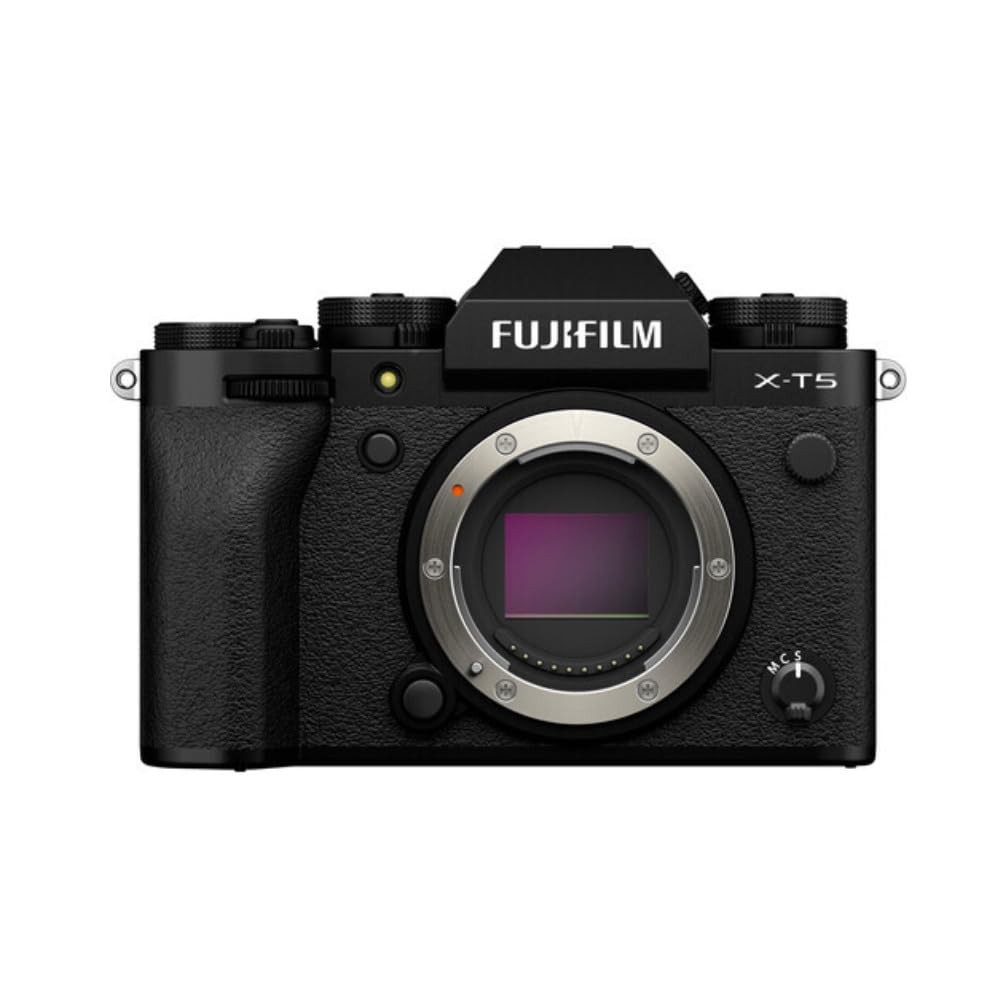
Fujifilm X-T5 Mirrorless Digital Camera Body - Black
Fujifilm X-T5 Mirrorless Digital Camera Body - Black is the straightforward recommendation for photographers who want the full X-T5 experience without additions. The black colorway is the more neutral choice for photographers who prefer their equipment to read as unobtrusive , street shooters, travel photographers, and documentary-adjacent work where a camera that disappears into the environment has practical value.
The X-Trans CMOS 5 HR sensor delivers 40.2 megapixels with the color response that Fujifilm’s X-Trans architecture is known for. Verified buyers across multiple review aggregators note the JPEG output as a consistent high point , the film simulations render with nuance that goes beyond stylistic presets, producing tonality and grain character that owners frequently describe as requiring no further editing. For photographers who want to reduce post-processing time without sacrificing output quality, that in-camera capability is a genuine efficiency gain.
Autofocus handles well-lit portraiture and street work confidently. Owner consensus points to reliable face detection in good light and somewhat more variable performance in challenging conditions , a characterization consistent with Fujifilm’s own positioning of this body as a high-resolution still photography tool rather than an action-priority system. The compact body with its full complement of physical dials rewards deliberate, considered shooting. Most buyers who prioritize image quality and shooting experience over video capability will find this the correct answer.
Check current price on Amazon.
Fujifilm X-T5 Mirrorless Digital Camera Body - Silver
The silver colorway of the same body carries a different character. Fujifilm X-T5 Mirrorless Digital Camera Body - Silver pairs the two-tone silver and black aesthetic with the X-T5’s retro-inspired chassis in a way that reads more explicitly as a rangefinder-influenced camera , a visual language that resonates with photographers drawn to Fujifilm partly for what the camera communicates about its relationship to craft.
The sensor, autofocus system, film simulations, and physical control layout are identical to the black variant. The decision between the two is entirely aesthetic. Community sentiment in r/Fujifilm skews toward the silver finish as the more distinctive of the two options, particularly when paired with silver-ringed Fujinon lenses like the XF 35mm f/1.4 R. Whether that matters to you depends on how much the physical presence of the camera contributes to your shooting experience.
What the silver variant offers that the black does not is visibility as a photographic object , it invites a different kind of attention and projects a different set of associations. Street photographers working in environments where the camera’s presence is a conversation starter may find that useful. Photographers who want the camera to read as equipment rather than aesthetic object may prefer the black. Both deliver identical image quality and handling.
Check current price on Amazon.
Fujifilm X-T5 Mirrorless Digital Camera Body Bundle with Greens Lens Cleaning Kit + 12 Inch Flexible Vlogging Tripod + Travel Camera Bag (Black)
For buyers stepping into the X-T5 without an existing accessory base, the bundle configuration makes practical sense. Fujifilm X-T5 Mirrorless Digital Camera Body Bundle with Greens Lens Cleaning Kit + 12 Inch Flexible Vlogging Tripod + Travel Camera Bag (Black) pairs the same black-body X-T5 with a lens cleaning kit, a flexible mini tripod, and a travel camera bag , the kind of accessories a first-time Fujifilm buyer will need to acquire regardless.
The bundle accessories are entry-level rather than premium. The flexible tripod is serviceable for tabletop work and casual self-timer use; it is not a substitute for a dedicated travel tripod for landscape or long-exposure work. The travel bag provides basic protection and portability. The lens cleaning kit is a utility item. None of these accessories will disappoint at their tier, but buyers with existing accessory kits or specific preferences about bags and tripods may find more value in purchasing the body alone and sourcing accessories independently.
The camera body itself is unchanged , 40.2 megapixels, X-Trans CMOS 5 HR, the same film simulation engine, the same physical control layout. For buyers who genuinely need those three accessories and are starting from zero, the convenience consolidation is worthwhile. The body-only black variant remains the recommendation for buyers who already have a bag, a tripod, and cleaning supplies.
Check current price on Amazon.
Buying Guide
Matching the X-T5 to Your Primary Shooting Application
The X-T5’s design choices are internally consistent and point toward a specific type of photographer. High resolution, compact size, tactile physical controls, and exceptional JPEG output form a coherent package , one that suits landscape, travel, portrait, street, and documentary work well. The photographers for whom the X-T5 is the obvious answer are those who prioritize image quality and shooting experience over burst-speed performance or comprehensive video capability.
Buyers whose shooting is primarily event-driven , weddings, sports, wildlife , should weigh the autofocus limitations documented by the owner community before committing. The X-T5 is not poorly specified for those applications, but it is not optimally specified for them either.
Video Capability: Honest Expectations
The X-T5 shoots 6.2K open-gate video and 4K at multiple frame rates. It does not have in-body image stabilization, which the X-T4 offered and which the X-H2 also includes. Handheld video without IBAS lens support will show camera movement. The recording time limit and the absence of a fully articulating screen are recurring points of friction in video-focused community discussions.
For photographers who shoot occasional video as a secondary activity, the X-T5’s video capability is more than adequate. For buyers whose primary use case is video, the X-H2 or X-H2S within the Fujifilm system address those gaps more directly. The X-T5’s video feature set reflects its design priorities honestly.
The Case for Buying Into Fujifilm’s Ecosystem
Committing to a lens system is a longer-term decision than buying a body. The Fujifilm X-mount ecosystem offers exceptional glass across the critical focal lengths , the XF 23mm f/1.4 R LM WR, XF 35mm f/1.4 R, XF 56mm f/1.2 R WR, and XF 16-80mm f/4 R OIS WR represent a portrait, street, and travel kit that competes at the highest level of APS-C optical quality. Reviewing the full breadth of Fujifilm camera bodies and lenses before purchase helps ensure the system covers the focal lengths your work demands.
Third-party options from Viltrox have expanded the affordable prime selection meaningfully. The ecosystem gap relative to Sony E-mount is real but narrowing, and for most shooting applications it is not a practical constraint.
New Buyer vs. Existing Fujifilm Shooter
The calculus differs substantially depending on whether you already hold X-mount glass. Existing Fujifilm shooters evaluating the X-T5 as an upgrade from an X-T3, X-T4, or X-S10 are making a straightforward sensor and body upgrade , all existing glass transfers directly, and the film simulation improvements since the fourth-generation X-Processor are meaningful.
New buyers should factor system investment into the total cost of entry. The X-T5 body is premium-priced, and building a capable lens kit alongside it is a significant additional commitment. That investment is well-placed for photographers who are confident in the Fujifilm system’s fit for their work , less so for buyers still exploring what camera system suits them best.
Weather Sealing and Environmental Conditions
The X-T5 body is weather-sealed with 79 sealing points, rated for operation down to 14°F (-10°C). Paired with weather-resistant Fujinon lenses , marked WR in the product name , the system provides meaningful protection against dust and moisture ingress in field conditions. Outdoor photographers, travel shooters, and anyone working in variable weather benefit from this specification.
Weather sealing is not waterproofing. Sustained rain, submersion, or salt spray will exceed what the sealing is designed to handle. The sealing coverage is consistent with competitive premium APS-C bodies and is sufficient for the environmental conditions most outdoor photographers regularly encounter.
Frequently Asked Questions
How does the Fujifilm X-T5 compare to the X-T4 for still photography?
The X-T5 carries a substantially higher-resolution sensor , 40.2 megapixels versus the X-T4’s 26.1 megapixels , and benefits from Fujifilm’s fifth-generation X-Processor for faster autofocus acquisition and improved subject recognition. The trade-off is the removal of in-body image stabilization in the X-T5’s primary design axis, where the X-T4 included IBAS. For still photographers prioritizing resolution and compact size over stabilization, owner consensus favors the X-T5 as the stronger body.
Is the Fujifilm X-T5 suitable for wildlife and sports photography?
The X-T5’s subject recognition autofocus covers birds and animals, and it performs reliably in good light with moderately paced subjects. Community reports from bird photographers note that the tracking holds well on predictable subjects in open environments. For fast, erratic motion or low-light tracking , diving birds, motorsport, indoor sports , the X-H2S is the more capable body within the Fujifilm system. The X-T5 is a capable wildlife camera for patient, deliberate shooting, not a dedicated action body.
What is the X-Trans sensor difference, and does it affect editing workflow?
X-Trans sensors use a pseudo-random 6×6 color filter pattern rather than the standard Bayer 2×2 grid, which reduces moiré and produces color rendering that photographers often describe as more film-like. The practical editing implication is that Lightroom’s X-Trans demosaicing is slower and occasionally less sharp at the pixel level than Fujifilm’s own raw converter or Capture One. Photographers who shoot primarily JPEG are largely unaffected. Raw shooters who edit in Lightroom should run a test workflow before committing fully to the system.
Does the bundle version include the same camera body as the body-only versions?
The Fujifilm X-T5 Mirrorless Digital Camera Body Bundle with Greens Lens Cleaning Kit + 12 Inch Flexible Vlogging Tripod + Travel Camera Bag (Black) contains the identical black X-T5 body as the body-only black version , same sensor, same processor, same film simulation engine, same physical controls. The bundle adds three entry-level accessories. Buyers who need those accessories and are starting from zero may find the bundle practical; buyers with existing kits should evaluate whether the accessory additions represent genuine value for their situation.
Should I choose the black or silver X-T5?
The black and silver X-T5 bodies are mechanically and optically identical , the choice is entirely aesthetic. The silver colorway pairs visually with the X-T5’s retro-influenced chassis and reads more explicitly as a heritage-influenced camera, particularly when paired with silver-ringed Fujinon lenses. The black variant reads as more neutral and inconspicuous. Neither choice affects image quality, autofocus, or any functional specification.
Fujifilm X-T5 Mirrorless Digital Camera Body - Black: Pros & Cons
- Film simulation modes for in-camera JPEG quality
- Compact body with tactile controls
- Smaller lens selection compared to full-frame systems
Where to Buy
Fujifilm X-T5 Mirrorless Digital Camera Body - BlackSee Fujifilm X-T5 Mirrorless Digital Came… on Amazon