
Fujifilm X-T5 Mirrorless Camera Review: Real-World Test

Affiliate disclosure: Some links on this page are affiliate links. If you buy through them we earn a small commission at no extra cost to you. Recommendations are research-driven; we don't claim personal use of every product reviewed. Product prices and availability are accurate as of the date published and are subject to change. Always check Amazon for current pricing before purchasing. Learn more.

Film simulation modes for in-camera JPEG quality
See Fujifilm X-T5 Mirrorless Digital Came… on AmazonThe X-T5 sits at the top of Fujifilm’s APS-C lineup, and the buyer questions around it are specific: how does the 40MP X-Trans sensor handle real-world shooting, does the autofocus hold up against Sony and Canon competition, and does the retro-control philosophy work for how you actually shoot? These are the questions worth answering before committing to a premium APS-C body. Fujifilm Cameras is a crowded category with strong options at every tier , the X-T5 earns its position, but it earns it for a particular kind of buyer.
The three listings covered here span body-only options in black and silver, plus a bundle configuration aimed at buyers who want a starter kit alongside the camera. The core camera is identical across all three.
What to Look For in a Fujifilm X-T5 Mirrorless Camera Body
Sensor Resolution and X-Trans Architecture
The X-T5 uses a 40.2MP BSI-CMOS X-Trans sensor , the highest resolution Fujifilm has shipped in an APS-C body. X-Trans is Fujifilm’s alternative to the standard Bayer color filter array. Where Bayer sensors use a repeating 2×2 RGGB pattern, X-Trans uses a pseudo-random 6×6 arrangement that eliminates the need for an optical low-pass filter and, according to Fujifilm, reduces moiré patterning without the sharpness cost of the filter.
In practice, the difference is most visible in fine detail rendering , fabric textures, foliage, architectural lines. DPReview’s sample comparisons consistently show the X-Trans rendering as slightly more film-like and less clinical than equivalent-megapixel Bayer sensors. The trade-off is that some RAW converters handle X-Trans demosaicing less gracefully than Bayer, and Lightroom’s X-Trans processing has historically drawn criticism for smearing fine detail at aggressive noise reduction settings. Capture One and Fujifilm’s own Pixel Shift processing tend to perform better.
At 40MP, the X-T5 also provides meaningful headroom for cropping , a practical advantage for wildlife and reach-limited telephoto work.
Autofocus: Subject Tracking and Real-World Reliability
Fujifilm’s autofocus has improved substantially across firmware generations. The X-T5 ships with phase-detection AF across the full sensor area, face and eye detection for humans and animals, and subject-recognition modes that cover birds, vehicles, and aircraft. Owner reports on r/Fujifilm note that the bird AF in particular has become reliable enough for serious wildlife work after the firmware updates released through 2023 and 2024.
Where the X-T5 continues to trail Sony’s a7R V and Canon’s R8 in direct comparisons is in low-contrast, low-light tracking , fast-moving subjects under difficult lighting remain an area where the Fujifilm system requires more deliberate technique than the competition. For portrait, street, landscape, and moderate wildlife work, the AF is capable. For fast sports or indoor event work under poor lighting, the gap is real.
The X-T5’s phase-detection system covers approximately the entire frame, and the minimum focus illumination is competitive with peer APS-C bodies.
Ergonomics and the Dedicated Dial System
The X-T5 reverts to the rangefinder-style body that defined the original X-T1 , smaller grip, flatter profile, and dedicated physical dials for shutter speed, ISO, and exposure compensation on top of the body. This is a deliberate departure from the X-T4, which added a deeper grip and in-body image stabilization (IBIS). The X-T5 drops IBIS in exchange for a smaller, lighter body.
The ergonomic trade-off is consequential. Photographers who prioritize tactile control and shoot deliberate, considered frames , street, landscape, travel , tend to prefer the X-T5’s handling strongly. Photographers who shoot handheld at slow shutter speeds, do significant video work, or prefer a deeper grip for telephoto lenses often find the X-T4 or X-H2 a better fit. The dial system rewards intentional exposure setting; it resists spray-and-pray shooting by design.
Film Simulations and In-Camera JPEG Quality
Fujifilm’s film simulations are the most discussed feature in the r/Fujifilm community, and the discussion is justified. The X-T5 includes 20 film simulation modes , Provia, Velvia, Astia, Classic Chrome, Pro Neg Hi and Std, Eterna, Acros, and others , each modeled on the response characteristics of specific Fujifilm film stocks. Provia is the general-purpose neutral baseline. Velvia is heavily saturated and contrasty, suited for landscape and nature. Classic Chrome, modeled on slide film with a documentary feel, has become the default for street and travel shooters across r/Fujifilm.
The quality floor for X-T5 JPEGs shot with a considered film simulation profile is high enough that many photographers , including travel and street shooters , shoot JPEG-only. The Fujifilm imaging pipeline handles color science in a way that no third-party profile in Lightroom fully replicates. This is not marketing language; it is the consistent finding of photographers who have compared the two workflows directly. For buyers who want to minimize post-processing time, the simulation system is a genuine differentiator. Exploring the full range of Fujifilm camera options before settling on the X-T5 is worthwhile if JPEG workflow is your primary criterion.
Top Picks
Fujifilm X-T5 Mirrorless Digital Camera Body - Black
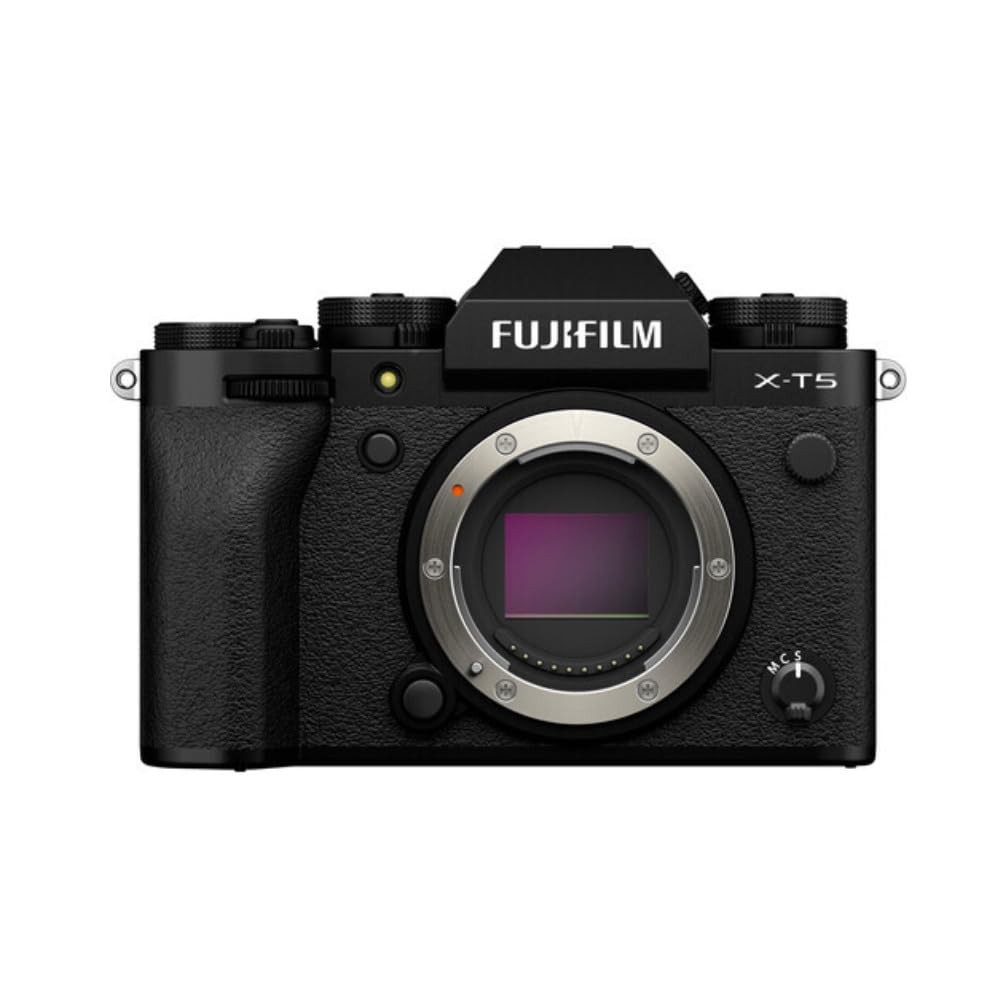
The Fujifilm X-T5 Mirrorless Digital Camera Body - Black is the primary recommendation for photographers who want the best imaging performance Fujifilm’s APS-C lineup offers in the most compact, control-forward body available. The 40MP X-Trans sensor is the draw , at this resolution and with Fujifilm’s color science behind it, the output quality for landscape, portrait, and documentary work is exceptional among APS-C options.
Owner consensus on r/Fujifilm points consistently to two strengths: the JPEG output from well-chosen film simulation profiles, and the handling confidence that comes from physical dials rather than menu-driven exposure control. Verified buyers across B&H and Amazon note that the body size rewards single-prime shooting , the combination of the X-T5 body with the Fujinon XF 35mm f/1.4 R or XF 23mm f/2 WR produces a kit that is genuinely pocketable for travel.
The 40MP resolution also means files are large , RAW files run approximately 80MB in uncompressed format , and the buffer, while improved over prior generations, fills faster than the X-H2S under sustained burst shooting. For photographers who prioritize image quality over speed, this is an acceptable trade. For sports and event shooters who need sustained high-speed burst, the X-H2S is the more appropriate body.
The black colorway is the neutral choice , it attracts less attention in street shooting contexts, and the black body with black lens caps reads as working camera rather than collector piece.
Check current price on Amazon.
Fujifilm X-T5 Mirrorless Digital Camera Body - Silver
The Fujifilm X-T5 Mirrorless Digital Camera Body - Silver is the same camera in a colorway that many X-series buyers actively prefer. The silver finish is not cosmetic novelty , it is a deliberate reference to the rangefinder aesthetic that defines Fujifilm’s industrial design language, and it pairs most naturally with silver-ring Fujinon lenses like the XF 35mm f/1.4 R and XF 18mm f/2 R.
For photographers drawn to the X-T5 specifically because of its retro handling philosophy, the silver colorway extends that aesthetic coherence throughout the kit. Verified buyers who mention the colorway in their reviews tend to be experienced Fujifilm shooters upgrading from X-T3 or X-T4 bodies, not first-time mirrorless buyers , the silver choice is a considered one.
The imaging performance, autofocus system, film simulations, and all other technical specifications are identical to the black body. The choice between them is entirely preference-driven. Photographers who shoot events or work where a lower-profile appearance matters sometimes prefer the black; photographers who treat the physical aesthetics of their kit as part of the experience often choose silver.
Check current price on Amazon.
Fujifilm X-T5 Mirrorless Digital Camera Body Bundle with Greens Lens Cleaning Kit + 12 Inch Flexible Vlogging Tripod + Travel Camera Bag (Black)
The Fujifilm X-T5 Mirrorless Digital Camera Body Bundle with Greens Lens Cleaning Kit + 12 Inch Flexible Vlogging Tripod + Travel Camara Bag (Black) packages the black X-T5 body with a lens cleaning kit, a small flexible tripod, and a travel bag. The accessories are entry-level , the flexible tripod is not a replacement for a full-height travel tripod for serious landscape work, and the bag’s quality will vary.
The bundle makes sense for one buyer profile specifically: someone buying the X-T5 as a first mirrorless camera who wants to avoid a separate accessories research process. The lens cleaning kit is genuinely useful regardless of experience level. The flexible tripod handles tabletop and low-angle work adequately, and there is value in having a bag that fits the body on day one without separately sourcing one.
Experienced photographers who already own a camera bag, a cleaning kit, and a tripod should buy the body-only black listing and skip the bundle , there is no reason to pay for accessories you already have. The bundle is priced at a modest premium over body-only, and the accessories justify that delta for buyers starting from zero.
Check current price on Amazon.
Buying Guide
Who the X-T5 Is Actually Built For
The X-T5 is optimized for still photography at high resolution with deliberate exposure control. The buyer who fits this camera best is someone who shoots landscape, travel, street, or portrait work; who wants the highest APS-C image quality available from Fujifilm; and who values a compact, tactile body over a deep grip and video-forward feature set.
Buyers whose primary use case is video should look at the X-H2 instead. The X-T5’s video capabilities are competent but not prioritized , no IBIS, a tilting screen rather than a fully articulating one, and a video feature set that reflects the camera’s still-photography orientation. The X-H2 addresses all of those gaps.
Understanding the IBIS Trade-Off
The removal of IBIS from the X-T5 is the most consequential spec decision in the body’s design. The X-T4 had five-axis IBIS rated to 6.5 stops. The X-T5 has none. Fujifilm made this trade to reduce body size and weight , the X-T5 is noticeably smaller and lighter than the X-T4.
For photographers who shoot mostly at faster shutter speeds, use optical stabilization in their lenses (many Fujinon primes and zooms include OIS), or work primarily from a tripod, the absence of IBIS is not a practical problem. For photographers who shoot handheld in low light at slower speeds , particularly with longer focal lengths , the gap matters. Lens-based OIS provides two to three stops of stabilization in most Fujinon OIS lenses; that is meaningful but not equivalent to the X-T4’s five-axis system.
Lens Ecosystem Fit
Fujifilm’s X-mount system includes over 40 native lenses, covering everything from the XF 8mm f/3.5 R WR ultra-wide to the XF 150-600mm f/5.6-8 R LM OIS WR telephoto zoom. The system is mature enough that most focal length and aperture requirements can be met natively. Third-party support from Viltrox, Tokina, and Sigma (via the Sigma 18-50mm f/2.8 and 56mm f/1.4 Contemporary) has expanded budget-tier options meaningfully.
The lens selection is smaller than Canon RF or Sony E mount. Full-frame shooters who need a wide range of ultra-fast prime options will find fewer native choices. For photographers building a one- or two-lens travel kit or a portrait-focused prime setup, the X-mount covers the ground well. Reviewing the full Fujifilm Cameras ecosystem , body options, lens pairings, and accessory compatibility , before committing to the X-T5 specifically is the right sequence for first-time Fujifilm buyers.
RAW Processing and Workflow Considerations
The X-Trans sensor’s demosaicing requires attention if RAW shooting is part of your workflow. Lightroom handles X-Trans files competently in recent versions, but the noise reduction algorithm still tends to smear fine detail at higher ISO when NR is applied aggressively. Capture One for Fujifilm , available as a perpetual license at a lower entry cost than the full Capture One suite , produces demonstrably better fine-detail rendering from X-Trans RAW files according to multiple side-by-side comparisons published by LensRentals and DPReview contributors.
JPEG shooters sidestep this entirely. The in-camera processing pipeline is Fujifilm’s own, and it handles X-Trans demosaicing natively. Photographers who shoot JPEG with film simulations and apply minimal post-processing will not encounter the Lightroom issue at all.
Buffer, Speed, and Burst Use Cases
At 40MP, each RAW file is large , approximately 79MB uncompressed, with lossless compressed RAW running around 40, 45MB. The X-T5’s buffer fills in roughly 20 frames of uncompressed RAW before the write speed becomes a constraint. Using a fast UHS-II SD card and selecting lossless compressed RAW rather than uncompressed extends the effective burst depth significantly.
For street and documentary work where bursts are short , two to five frames , the buffer behavior is not a practical issue. For wildlife or sports photographers who regularly need 15-plus frame bursts, the buffer limitation is real. The X-H2S, with its stacked sensor and significantly larger buffer, is the appropriate Fujifilm body for that use case.
Frequently Asked Questions
How does the Fujifilm X-T5 compare to the X-T4 for still photography?
The X-T5 offers higher resolution , 40MP versus 26MP , and a more compact body, but removes the in-body image stabilization that made the X-T4 attractive for handheld low-light work. For photographers who prioritize resolution and portability and shoot at shutter speeds where IBIS is less critical, the X-T5 is the stronger choice. Photographers who depend on IBIS for handheld slow-shutter shooting should weigh that trade carefully before upgrading.
Does the X-T5 work well for video shooting?
The X-T5 records 6.2K video at up to 30fps and 4K at up to 60fps, which are capable specs. However, the body lacks IBIS, uses a tilting rather than fully articulating screen, and does not include headphone monitoring without an adapter. Verified buyers who use the X-T5 primarily for stills and occasional video find it adequate. Dedicated video shooters or hybrid shooters who spend significant time on video work will be better served by the X-H2.
Is the Fujifilm X-mount lens ecosystem large enough to build a full kit?
The X-mount system includes over 40 native Fujinon lenses, with additional third-party options from Viltrox and Sigma covering key gaps in the budget and mid-range tiers. For most shooting disciplines , street, landscape, portrait, travel , the system provides enough choice to build a capable kit without compromise. The gap relative to Sony E-mount or Canon RF is primarily in ultra-fast prime options and the breadth of third-party professional glass.
What is the difference between the black and silver X-T5 body options?
The black and silver versions of the X-T5 are technically identical , same sensor, same processor, same autofocus system, same feature set. The choice is purely aesthetic. The silver colorway pairs naturally with silver-ring Fujinon lenses and extends the rangefinder aesthetic of the X-series design language. The black colorway is lower-profile for street shooting contexts.
Should a first-time mirrorless buyer choose the bundle or the body-only listing?
The Fujifilm X-T5 bundle makes practical sense for buyers who do not already own a camera bag, a lens cleaning kit, and a compact tripod. The accessories are entry-level but functional, and the bundle removes the friction of sourcing them separately. Buyers who are upgrading from an existing mirrorless system and already have these items should buy the body-only listing , paying for accessories you already own adds no value.
Fujifilm X-T5 Mirrorless Digital Camera Body - Black: Pros & Cons
- Film simulation modes for in-camera JPEG quality
- Compact body with tactile controls
- Smaller lens selection compared to full-frame systems
Where to Buy
Fujifilm X-T5 Mirrorless Digital Camera Body - BlackSee Fujifilm X-T5 Mirrorless Digital Came… on Amazon